Author Q&A: Stephen Selby

Share

Stephen Selby is a person who has kept busy over his seven decades. Once a civil servant in the colonial government of Hong Kong, he has been a radio presenter and academic, before trying his hand at writing for children. Stephen is a sinophile who in addition to speaking English, Cantonese and Mandarin, also speaks French.

How did you become a writer?

My father worked in the printing ink industry and had a great love of beautifully-illustrated children’s books. Some of my happiest childhood memories are of him reading books to me such as Kathleen Hale’s Orlando the Marmalade Cat, the stories by CAM (Barbara Mary Campbell), and later the books of B.B. (Denys Watkins-Pitchford), especially The Little Grey Men and Down the Bright Stream.

He would firmly refuse to read me any book that lacked both a good story and beautiful illustrations. He had little time for Enid Blyton or for books such as Rupert Bear, however popular they may have been. The detailed illustrations and gentle storytelling of the books that he brought home each week from Foyles bookshop made a lasting impression on me.

About 20 years ago, I tried to persuade the modern successor to the original publisher of Barbara Mary Campbell’s wonderful children’s books, the books that I had read as a child, to republish the series. In the end, however, it became clear that some attitudes and expressions which had passed without comment in the middle of the 20th century no longer belonged comfortably in the modern world.

My idea of republishing them would never work. Apart from some periods of teaching, my major career was in the Hong Kong civil service.

Civil servants spend about 60% of their time writing boring things. But we gained a pretty good training in writing boring things concisely and clearly, particularly keeping in mind that many of the readers of our English output might not be native speakers.

In the 1980s, I started a website on archery and in subsequent years, I wrote several academic books and articles related to archery and Chinese history.

However, I’m not a good academic writer. I feel that academic writers perform as if under attack. You have to be right at the very top of the academic tree to be allowed to let your imagination fly away.

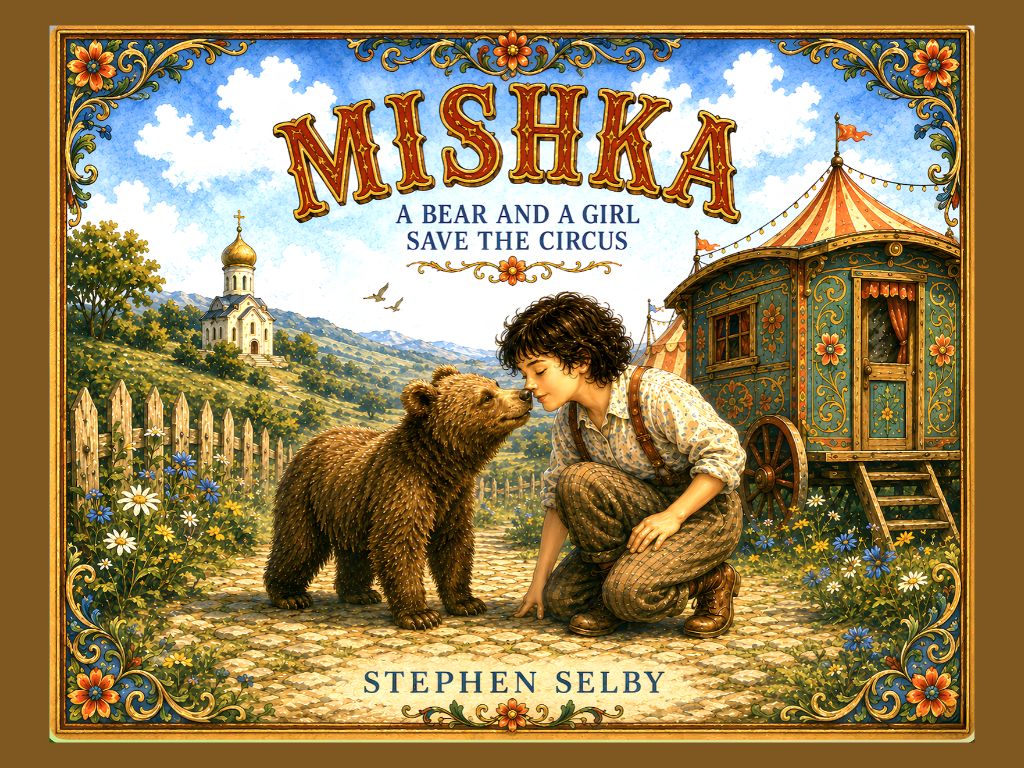
My own academic position remains somewhere down near the lowest branches of the tree. The immediate origin of my first children’s book, Mishka. A Bear and a Girl Save the Circus. was much closer to home.

When my children were young, I wanted to repeat for them the experiences that I had enjoyed with my own father. We often read together in the evenings.

Whenever we ran out of books or when I was driving the car with the children in the back, I and my wife, Anne, would invent stories of our own. One of those improvised stories concerned a little bear and the circus girl who rescued her. My story of the bear remained in my memory. Eventually I decided to write it down properly. My aim was not to reproduce the books of my childhood exactly, because society changes and each generation tells stories in different ways. Instead, I hoped to recreate something of the warmth, kindness and eye-popping illustration that I remembered from those books, while leaving behind assumptions and attitudes that belonged to an earlier age. 

What would you be doing otherwise?

As little as possible. I’m rather lazy. Although I have a teaching position, I’ve retired now, and
I spend most of my time at home with my dogs.

Of the characters you have created, which is your favourite and why?

My academic writing has never focused on individual people. A lot of my academic writing has been based on translations from Chinese or French. What has fascinated me is those classes of people who have been swept aside to the edges of Chinese society.

I recently translated a long work from French about the details of the Chinese imperial examination system.

In the account that I worked on, I discovered classes of people who were down at the bottom of the pecking order in Chinese society and, for various reasons, were never allowed to take the imperial exams that dominated the lives of the upper classes.

There was a sort of pariah group called the ‘Fallen people’ (堕⺠) who were never allowed to marry out of their class. There were the Tanka people (Boat people 蛋家) who were never allowed to marry people who were from the agricultural classes. Musicians and actors were banned from rising within Chinese society, although they played such an important role in the day-to-day life of ordinary people and the upper classes.

In my book, Mishka , I’ve made it clear that the community I describe is a ‘Gypsy’ travelling circus. (I don’t use the word in my book because it’s now considered pejorative, notwithstanding that that is what the travelling people call themselves).

The theme of how people from this marginal group coexist with the rest of society is interwoven with the plot of my new children’s story ‘Mishka. A Bear and a Girl Save the Circus’.

Tell us about your writing method. Is there a secret?

I think children’s books need to centre around lots of detailed and interesting pictures. From writing Mishka, I have found that I need to have pictures in my mind which follow different parts of the pulse in the plot of the book. From the pictures, I developed the story, not the other way round.

Recently, I translated the ancient Chinese work ‘Gui Gu Zi’(《⿁⾕⼦》)into English (‘The Art of Persuasion’ Earnshaw Books, 2026) . I adopted the same approach. I read the Chinese, then I created an image in my mind and described the image in English. There was no way to convey the inner meaning of this difficult work by using a close translation.

When I deal with children in daily life or when writing for them, I adopt this principle: never patronise children; never underestimate what they understand. Children are curious about the adult world, not just about unicorns and rainbows.

Children in the 7-14 age group are in a fact-collecting stage of their mental development. They try to emulate the grasp of technical detail that they believe that adults have. They relish collecting stuff like the names of dinosaurs, obscure makes of cars or the technical details of firefighting.

Ideally, a book will be read to children by an adult. Although Mishka is written in English, in the illustrations, all the text is in a strange foreign script: Ukrainian. The children will ask questions. Either an adult will answer the questions, or they will go together to see if they can find the answer.

I’m not afraid of scattering unexplained mysteries and adult controversies for children to explore.

I want to address one issue front-on: that is, my use of AI. I have never used AI in writing my story, but I have never used anything but AI for illustrating it.

AI illustration has allowed me to explore visual concepts and produce ideas that are much more difficult to achieve with a living illustrator. I know what I want in my illustrations, but unlike Barbara Mary Campbell, I just don’t have the skills to produce them myself. Frankly, the modern illustrators that I’ve met don’t have the skills either.

Which author, alive or dead, would you most like to meet?

I wish I’d had a chance to meet Barbara Mary Campbell. I believe she died in the 1980s. She could do one of the things that I can’t achieve: she could tell a good story and paint amazing images. She didn’t just paint the pictures; she actually set out the text of her stories in her own calligraphy. I expect that she is not widely known now. She was a big name in the late 1940s and the 1950s.

What advice would you give your younger, writer self?

I’m 75 years old now, and Mishka is my first children’s book. I should really have started writing children’s books much earlier.

Sometimes people think that I have lived an interesting life and that I should write an autobiography; but I know in my heart that it would be very boring. There are many elderly people out there like me.

Just get stories down about yourself, but through the eyes of a children’s story writer.

Mishka contains many fictionalised elements from my own life experiences that would never be able to appear in an autobiography. It’s a collage of images and memories, woven into a fantasy.

Will Mishka be a popular book? I don’t know. Rather than competing in a market which is oversaturated and which involves publishers who have resistance to anything involving the use of AI, I have published the book myself. All the costs of designing and printing the book came from charitable donations and all the revenue from selling it will be given to a charity.

It would be lovely if Mishka became hugely popular, but I don’t harbour any great expectations.

Contact Stephen Selby to order copies of ‘Mishka. A Bear and a Girl Save the Circus’  here. 

Share

About the Author

Bookish Everybody

Books and reading are too often on the periphery. Enter: Bookish Everybody, a one-stop community of book enthusiasts to read or write reviews, join read-alongs, buy/sell/give books and join our competitions to win books:  www.bookisheverybody.com.

Shop Now
Visit Bookazine's online store.

NEW STORIES

Latest Posts

Stay Up To Date

Want the latest insights and fresh content delivered straight to your inbox? Subscribe to our newsletter and stay updated with our exclusive content!