Being Neighbourly captures the diversity of Hong Kong's islands from Lamma to Cheung Chau.
Author/
Being Neighbourly
Share
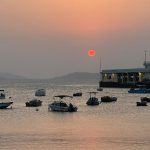
The sun going down near the Yung Shue Wan ferry pier.
The Islands District falls under the New Territories. It consists of 20 large and small islands which lie to the south and southwest of Hong Kong. Hong Kong includes 263 islands meaning that the vast majority are not part of the district. The term Outlying Islands tends to refer to the islands of the Islands District. In addition to the four main islands we write about, the lesser known Cha Kwo Chau, Hei Ling Chau, Kau Yi Chau, Po Toi Islands, Shek Kwu Chau and Soko Islands also fall under the Islands District.
Land Area 175 km2
Population* 185,282
*2021 figures
Biggest Neighbourhood Tung Chung
Lantau
Lantau Island, often referred to as the green lungs of Hong Kong, is the largest island in Hong Kong. The largest country park of Hong Kong, Lantau South Country Park is located on the island, which hosts two other parks. These green spaces cover slightly more than half of the area of Lantau Island.
Lantau is west of Hong Kong Island and the Kowloon Peninsula. Originally an island of fishing villages, it has come a long way with the construction of Tung Chung New Town on its north-western coast and includes such tourist attractions as Ngong Ping, Tai O and Disneyland Hong Kong. Chinese white dolphins, often called pink dolphins, can sometimes be seen off the coast of Lantau.
Chek Lap Kok, where Hong Kong International Airport is situated, is located just off the north coast of Lantau Island and not on Lantau itself. Chek Lap Kok is also the location of Hong Kong SkyCity, a business and entertainment complex, and AsiaWorld–Expo, a convention and exhibition centre, opened in 2005. Originally, a hilly 4 sq km island, Chek Lap Kok is currently 12.5 sq km.
How to get there:
MTR (Subway): Take the Tung Chung line from Hong Kong Station or Central Station to Tung Chung Station. The ride takes roughly 30 mins.
Ferry: Take a ferry from Central Pier 6 to Mui Wo on Lantau Island. The slow ferry takes about 50 to 55 mins, and the fast ferry takes around 35 to 40 mins. Ferries also run to Discovery Bay.
Bus: Numerous public buses run from various city locations directly onto the island, or from Tung Chung town center to Tai O or Ngong Ping.
Taxi: Urban (red) or Lantau (blue) taxis can access the island via major bridges. Blue taxis operate specifically for travel within Lantau Island.
A meal on Lamma is an absolute must.
Lamma
Lamma Island, also known as Y Island, Pok Liu Chau or simply Pok Liu, is the third largest island in Hong Kong. It is a welcome retreat from city life for day trippers and with cheaper rents, attracts artists, musicians and younger people.It has a significant expatriate community as well.Buildings higher than three storeys are prohibited and there are no vehicles, just small-sized fire trucks and ambulances, as well as village vehicles; distinctive open-back vehicles to transport construction materials.
There are three Tin Hau temples on Lamma, located in Yung Shue Wan, Sok Kwu Wan,and Luk Chau Village and Tin Hau Festival (23rd of the third month of the Lunar Calendar) is widely celebrated there. Lamma Island is also one of the few remaining places in Hong Kong where traditional Chinese New Year celebrations still take place: at the stroke of midnight, fireworks are set off by the main families of the villages to frighten away the evil spirits.
How to get there:
The best way to get to Lamma Island is by ferry from Central Pier 4 on Hong Kong Island.
To Yung Shue Wan (North): Departs from Central Pier 4 and takes about 20-30 minutes. This route drops you off at the main residential and restaurant village.
To Sok Kwu Wan (South/Center): Departs from Central Pier 4 and takes about 30-45 minutes. This route leads to the quieter side known for seafood.
Alternative Route: You can also take a kaito ferry from Aberdeen on Hong Kong Island to Mo Tat Wan or Sok Kwu Wan.
Cheung Chau is famous for its annual Bun Festival in April or May. Photos: HKTB.
Cheung Chau
Cheung Chau, ‘Long Island’ is located 10 km southwest of Hong Kong Island and used to be a fishing village where more residents lived on boats than on land. Much of the island’s diverse population was involved in fishing.
These days, though, Cheung Chau is well-developed with shops and houses. Like Peng Chau, there are no conventional cars, but small motorised trucks, which include mini-fire engines, ambulances and police cars. Cheung Chau still has fishing fleets working from the harbour. However, in recent years, the island has become a tourist attraction, offering a mixture of sandy swimming beaches, seafood cafés and traditional Chinese culture.
The annual Cheung Chau Bun Festival, which lasts three to four days, is another draw, attracting tens of thousands of visitors to the island. It includes a parade of floats, including young children dressed as famous characters balancing as if they are floating mid-air. While the thought of crowds might be off-putting to some, Peng Chau is worth a visit at non-peak times.
How to get there:
You can get to Cheung Chau Island by taking a ferry from Central Pier 5 on Hong Kong Island. Ferries run regularly throughout the day from Central Pier 5 and take from 35-60 mins. You can pay with cash or Octopus Card.
Peng Chau
Peng Chau has an area of 0.99 km2 and a perimeter of some 5 km. Its main landmarks include: the tallest point of the island, Finger Hill, which stands 95 m (312 ft) in height and its temples, fishing and seafood. Among the temples are: Tin Hau Temple built in 1792, Golden Flower Shrine, dedicated to Lady Kam Fa, Lung Mo Temple and Seven Sisters Temple. The Fook Yuen Leather Factory, originally built in 1936, has been revitalised into a public art space now known as Leather Factory, or Secret Garden, locally. Designated a Grade III historic building in 2010, local artist Sherry Lau transformed the crumbling ruins into a community art hub.
How to get there:
You can reach Peng Chau island by ferry from Central Pier 6 on Hong Kong Island.
Fast Ferry: Takes about 25-30 mins.
Ordinary Ferry: Takes about 40 mins.
Payment: You can pay with cash or Octopus card.
Alternative Routes include:
Inter-Island Ferry: Connected via Sun Ferry services coming from Mui Wo or Chi Ma Wan (Lantau Island) and Cheung Chau.
From Discovery Bay: Kaito or localised green transport options also connect nearby Discovery Bay to Peng Chau.
Stay posted for our Islands insider guides coming soon.
Share
About the Author
Being Neighbourly
For over 20 years, the people behind BN have been creating content on the best things in life: food, travel and inspirational people.
Ditch The Cafes
Experience a 5-star flexible workspace just 4 minutes from the MTR