Sculpting the Void, The Asia Society Hong Kong Center
Author/ Katie Dowson
Share
The Wealth Vase by Lee Kuang-Yu. Courtesy of The Asia Society Hong Kong Center.
Sculpting the Void, the first large-scale solo exhibition by artist Lee Kuang-Yu in Hong Kong, opened at The Asia Society Hong Kong Center on 20 March 2025. Collaboratively organised by The Asia Society and Taiwanese art gallery Chini Gallery, the exhibition features nine of Lee’s bronze sculptural works, presented in a mostly alfresco manner.
While making your way through the exhibition space, there are multiple areas to wander or rest, making it an enjoyable way to spend an afternoon.
Five of Lee’s pieces are placed in the venue’s outdoor spaces, offering “a visual dialogue between the art and the setting.” The remaining four smaller sculptures are temporarily housed in The Asia Society’s entrance lobby, giving visitors their first visual introduction to the artists’ work. Several books depicting more of Lee’s work are also available for perusal in the foyer.
Lee was born in 1954 in Kaohsiung, Taiwan. It was during the mid-1970s that Lee began his artistic career, enrolling at the National Taiwan Academy of Arts, where he received formal sculptural training that would inform his later practices. He then moved abroad to Spain, training in Western sculptural techniques, earning a master’s degree.
Lee’s work revolves around the beauty of landscape and Eastern-based philosophies, with influences drawn from the Surrealist and Cubist art movements. His own artistic practice has led him to the creation of something he refers to as “the void”, which The Asia Society describes as “a concept that symbolises the unification of the object and the self”. Lee has exhibited worldwide and is currently based in Taipei, Taiwan.
Empty Procession by Lee Kuang-Yu. Courtesy of The Asia Society Hong Kong Center.
Three of the five outdoor works are figurative sculptures, all of which share several commonalities. Each of these works has been composed in such a way that, even while constructed from metal, they feel shaped out of something far more delicate. The oxidation of their bronze surfaces is also a shared trait, with varying degrees of colour change and speckling giving each piece its own distinctive personality. These works also all seem humanlike at certain angles, but not at others, created to be viewed as abstract forms.
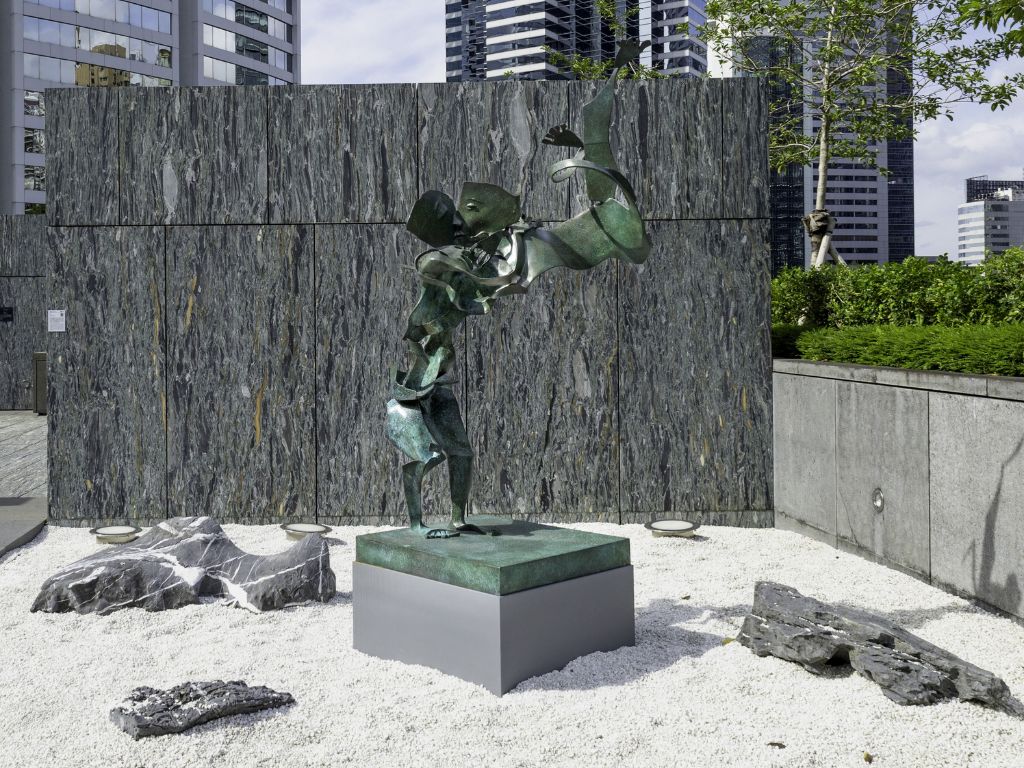
Empty Procession, created in 2014, is the first of the figurative works by Lee that one is likely to encounter. Found in the Joseph Lau and Josephine Lau Rooftop Garden, the sculpture is inspired by the Dakini, a female spiritual figure in Tibetan Buddhism representing insight and compassion.The figure’s toe touches the back of a holy turtle to symbolise masculine energy, balancing out the femininity of the piece and expressing “the harmony of yin and yang”. The figure’s other leg is bent into a half-lotus position, giving the work a flowing and graceful quality.
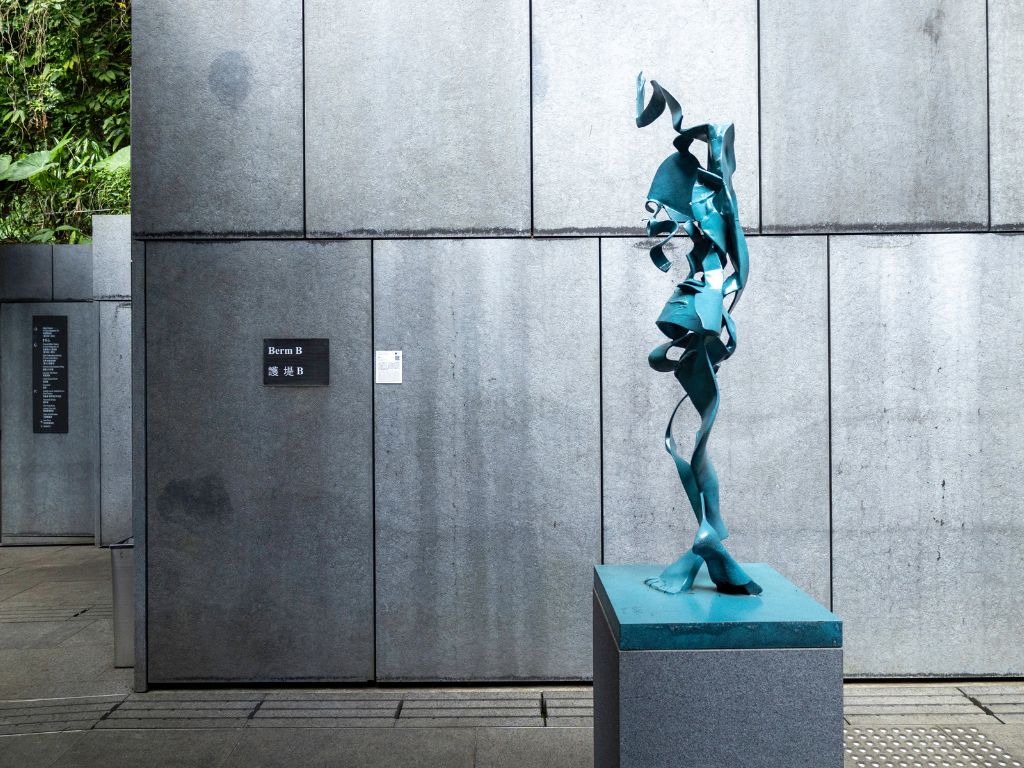
Another work featured in the rooftop garden is Lee’s 2019 sculpture, Bringing Auspicious News. This mighty figure, inspired by the Phoenix bird from Greek mythology, is waiting for “the arrival of auspicious blessings from the heavens”, symbolising the idea of transformation. Though slender in form, its structure has multiple expressions of dimension and movement, such as a hand grasping at its back or feet grounded into the work’s base. Both its partially split head and extra pair of floating feet drive home the concept of metamorphosis, appearing at some angles as two separate individuals interacting with each other and at others as a single entity.
Bringing Auspiscious by Lee Kuang-YuNews. Courtesy of The Asia Society Hong Kong Center.
Splendor of Dance by Lee Kuang-Yu. Courtesy of The Asia Society Hong Kong Center.
The third of the exhibit’s figurative works to spotlight is the 2021 piece, Splendor of Dance, which can be found in a corner near the Chantal Miller Gallery, a pleasant surprise to stumble upon in an exploration of the venue. This work is inspired by the Buddhist concept of “the moon in the water, the flower in the mirror”, an idiom to describe something not based in reality. Its dancing body-like appearance feels almost alive through the use of winding,intertwining metal plates that have been pieced together to create a vibrant yet dreamy atmosphere. While rooted thematically in ancient beliefs, the cut-outs that form the figure’s smooth face feel contemporary, their simple shapes goading interest and contrasting with its rougher textures.
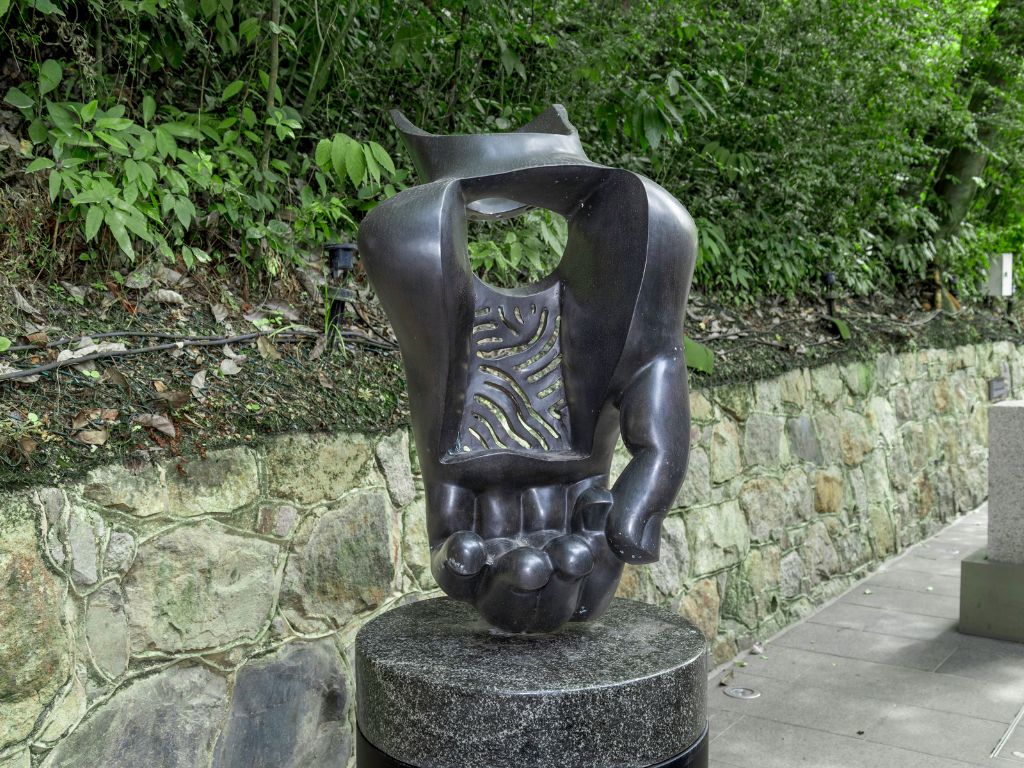
Also located near the Chantal Miller Gallery is the 2008 sculpture The Wealth Vase, a work representing “wealth, prosperity, and a life of abundance and peace”. Its form is that of a downward curled hand, with a hole and slivered shapes cut into its palm, creating a silhouette of a bottle. Through its curved lines and thick structure, the piece oozes calm and safety, as traditional sculptural methods demonstrate playfulness.
Floral Offering by Lee Kuang-Yu. Courtesy of The Asia Society Hong Kong Center.
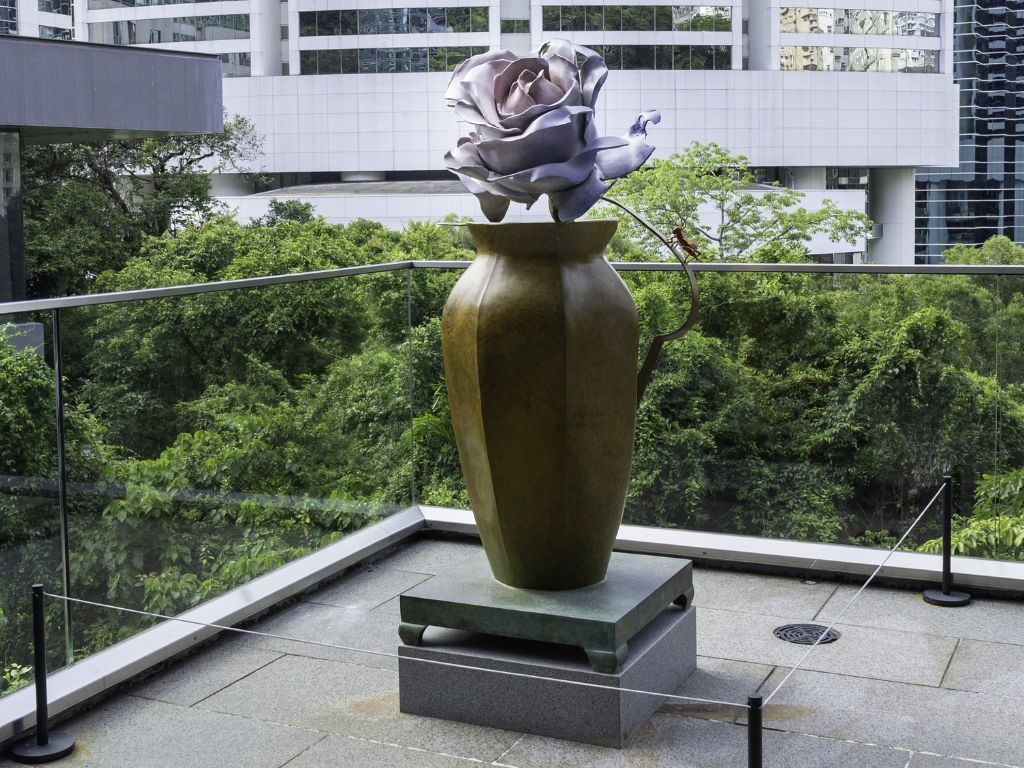
The last highlighted work is the 2023 work Floral Offering. Itdepicts a carved rose in a large, straight-edged vase that features a grasshopper on its handle. It is one of three works in the show that involve flowers in containers, the other two being Blue Trip and Magnificent Trip, which are both displayed in the main building’s lobby space. With Floral Offering, Lee aims to guide the viewer to contemplate “the resonance and harmonious beauty of life between impermanence and eternity”. The sculpture is perfectly placed on a platform’s edge so that it can be viewed from a variety of vantages on two different walkway levels, marking the intersection of the constructed part of the exhibition venue and its green surroundings.
Sculpting the Void is on at The Asia Society Hong Kong Center until 22 February 2026 (www.asiasociety.org).
Share
About the Gallery
Asia Society Hong Kong Center (ASHK) is an independent non-governmental educational organization established in 1990 by a group of Hong Kong community leaders led by Sir Quo-wei Lee, then Chairman of Hang Seng Bank. It is one of 16 centers of Asia Society’s diverse network across the globe, with the mission to navigate shared futures for Asia and the world in the fields of arts and culture, business and policy.
Since 2012, ASHK is situated at the Former Explosives Magazine of the Victoria Barracks, a site steeped in history, cultural significance and natural beauty. The 1.3 hectares site, housing four former British military buildings, was built by the British Army in the mid-19th century for explosives and ammunition production and storage. The heritage site has been transformed into a cultural and intellectual hub, combining heritage preservation with a modern aesthetic with world-class performance and conference facilities that offer a broad range of arts and culture, business and policy programs, and exhibitions to the community.
About the Author
Katie Lee Dowson
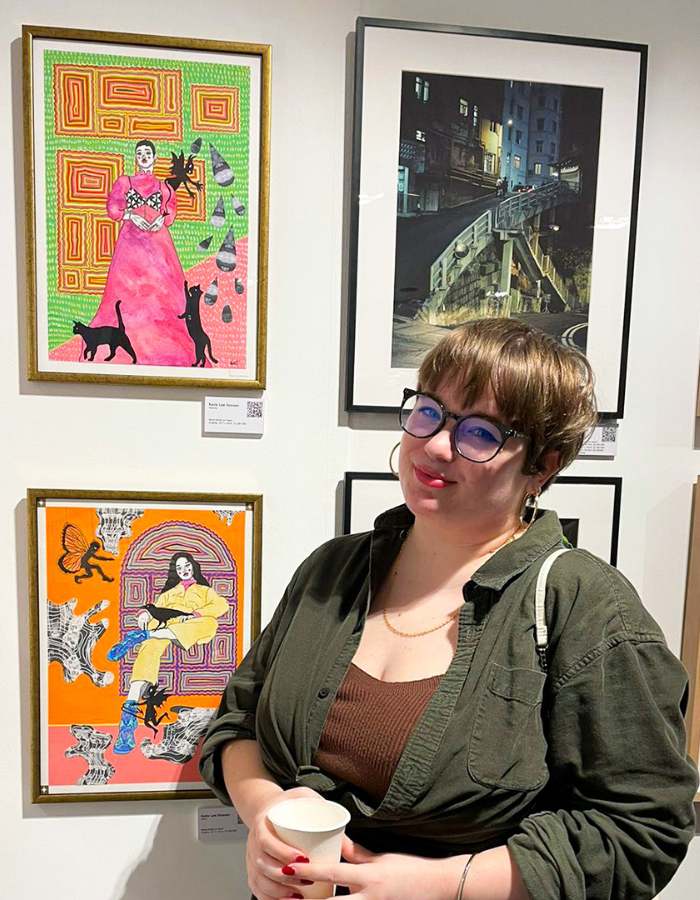
Katie Lee Dowson is an artist and graphic designer based in Hong Kong. Her personal projects have explored a wide range of themes and subjects in formats ranging from analog illustration to digital collage. Currently, she is experimenting with artworks that focus on identity, mental health and folklore: @katieleedowsonart.
Join the Book Group
Read and write reviews; win prizes; and be with the like-minded. It's free!